
Criminal Court Records in Otsego County
A criminal court record is the official case file a court clerk builds once charges are filed against a defendant. It is far more than an arrest note. The file holds the charging document, the arraignment entry, every bond and motion, each scheduled hearing, the plea or verdict, and the judgment of sentence. In Otsego County the County Clerk serves as Clerk of the 46th Circuit Court and keeps felony case files, while the 87-A District Court clerk keeps misdemeanor files. The record is built and maintained under Michigan Court Rules, which set what is public and what stays closed.
Which court holds the file depends on how serious the charge is. Felony cases, meaning crimes that can carry a prison term, are circuit court records after the case is bound over from the district court. Misdemeanors punishable by less than one year in jail stay in the 87-A District Court, which also handles the first steps of a felony such as arraignment and the preliminary examination. Traffic misdemeanors like operating while intoxicated also run through the district court. A single defendant can therefore have separate files in two Gaylord courts at once.
How to Search Otsego County Criminal Court Records
The main public tool is the statewide MiCOURT Case Search, which can return criminal, civil, traffic, and family cases from participating Michigan courts. Otsego links circuit cases through the 46th Circuit Court site and routes 87-A District and probate cases through the Circuit46 lookup. The county Case Lookup page carries an important warning: the search does not show whether a case is in warrant status.
- Open MiCOURT Case Search and choose the Otsego court that fits the charge, meaning the 46th Circuit Court for felonies or the 87-A District Court for misdemeanors.
- Search by the defendant's name, or by case number if you already have it.
- Narrow the results by court, case type, and filing date to find the right file.
- Open the case to read the docket entries, the charge list, and the disposition.
- Request a certified copy from the clerk of the court that created the file when you need an official document.
Not every older or sealed file appears online. For records that do not display, the reliable route is a copy request to the County Clerk at 225 W Main Street for circuit files, or to the 87-A District Court clerk at the Alpine Center for district files. Statewide criminal history sits in a separate system covered further below.
Stages of an Otsego County Criminal Case
A criminal case moves through a set order of steps, and each step leaves a mark in the record. Reading a file is easier once you know where each event belongs. Felony cases begin in the 87-A District Court, then shift to the 46th Circuit Court after bindover, so the same case can span two dockets.
Case flow: Charges Filed › Arraignment › Pretrial / Motions › Plea or Trial › Disposition › Sentencing
| Stage | What Happens |
|---|---|
| Arraignment | The defendant hears the charges, is told their rights, enters a first plea, and the court sets bond or release conditions. |
| Pretrial / Motions | Lawyers exchange evidence, file motions, and often negotiate. Felonies pass through a preliminary examination and bindover to circuit court. |
| Plea or Trial | Most cases end in a plea. Others go to a bench or jury trial where guilt is decided beyond a reasonable doubt. |
| Sentencing | After a plea or a guilty verdict, the judge imposes a sentence such as jail, prison, probation, fines, costs, or restitution. |
The charges that begin this chain are covered more closely on the arrest records and court charges page, which follows the path from arrest to the prosecutor's filing.
What an Otsego County Criminal Court Record Shows
A full criminal file collects the same core fields across circuit and district cases, even though the case numbers and forms differ. Reading these fields tells you what the person was accused of and how the court answered. The table below breaks down the parts a searcher meets most often.
| Field | What It Shows |
|---|---|
| Case Number | The court's unique file identifier. Format varies by court and case type, so a felony and a misdemeanor number look different. |
| Defendant | The person accused. Criminal files name the People of the State of Michigan as the charging party against the defendant. |
| Charges | Each count with its charge description, statute code, class, and severity level. One arrest can list several separate charges. |
| Plea | The defendant's formal answer to each count, such as guilty, not guilty, or no contest. |
| Disposition | How each charge ended, for example convicted, dismissed, acquitted, or reduced. |
| Sentence | The punishment or conditions imposed, including jail or prison terms, probation, fines, costs, and restitution. |
Docket events fill in the story between these fields. Entries note the arraignment, preliminary examination, bindover, motions, hearing notices, continuances, probation violation hearings, and any bench warrant. Financial lines track bond, fines, costs, and restitution owed.
The Prosecuting Attorney's Role
Michigan counties use a Prosecuting Attorney rather than a District Attorney. Otsego County Prosecuting Attorney Michael A. Rola leads the office that reviews police submissions and decides which charges to file. The Prosecuting Attorney's office sits at 800 Livingston Boulevard, Suite 3-D, in Gaylord and can be reached at 989-731-7430. Every count in a criminal record traces back to a charging decision by this office.
Felony charges generally begin with a district court arraignment and a preliminary examination, then move to the 46th Circuit Court if the case is bound over. Misdemeanors stay in the 87-A District Court from start to finish. The office also employs a crime victim advocate who handles victim impact and restitution matters, though victim service files are not open public case records.
Charges vs. Convictions
Being charged is not the same as being convicted. A criminal court record can show counts that were later dropped, dismissed, reduced, or that ended in acquittal at trial. A charge is only an accusation supported by probable cause. A conviction requires proof beyond a reasonable doubt or a guilty plea accepted by the court. Reading a file carefully avoids treating an open or dismissed charge as proof of guilt.
| Charge | Conviction | |
|---|---|---|
| Stage | Accusation | Verdict or plea |
| Burden of Proof | Probable cause | Beyond reasonable doubt |
| Public Record | Yes | Yes |
Note: A dismissed or acquitted charge still appears in the public file unless the court later sets the record aside under Michigan law.
Reading Dispositions and Sentences
The disposition is the outcome of each charge, and it is one of the most read parts of any criminal file. Common entries include guilty, not guilty, dismissed, and no contest, which is a plea that accepts the penalty without admitting the facts. A disposition reason may name a plea deal, a time-served credit, or a dismissal by the prosecutor.
The sentence follows a conviction and states the actual consequence. In Otsego County that can range from fines and costs in a district misdemeanor to a state prison term in a circuit felony. Sentences often bundle several parts at once, such as jail time, probation supervision, fines, court costs, and restitution to a victim. Probation places the defendant under community supervision, while parole is later supervision after release from state prison. A judgment of sentence is the signed document that fixes these terms.
Sealed vs. Expunged (Set Aside) Records
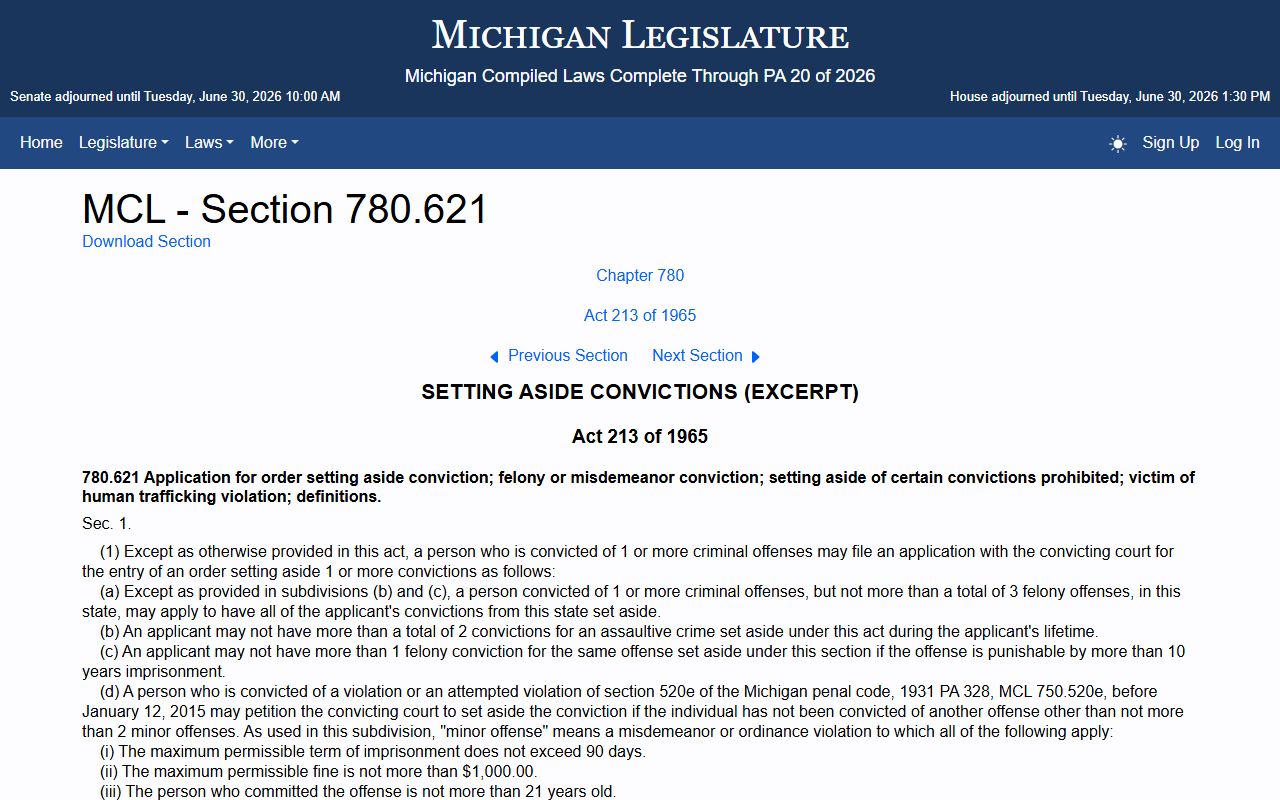
Michigan's term for clearing an eligible conviction is a set aside, though many readers call it expungement. A person applies in the court where the conviction happened, so Otsego felony convictions route to the 46th Circuit Court and misdemeanors route to the 87-A District Court. The set-aside statute at MCL 780.621 lets eligible convictions be set aside after the required waiting period, subject to offense limits and the number of prior convictions.
The statute that spells out the rules is a useful reference for anyone weighing eligibility. The set-aside application form details how convictions qualify.
A researcher can review the underlying law directly on the Michigan Legislature set-aside page.
Once a conviction is set aside, ordinary public searches no longer show it, though some agencies keep statutory access. The effects of a set aside, including special handling for traffic offenses, are laid out at MCL 780.621c.
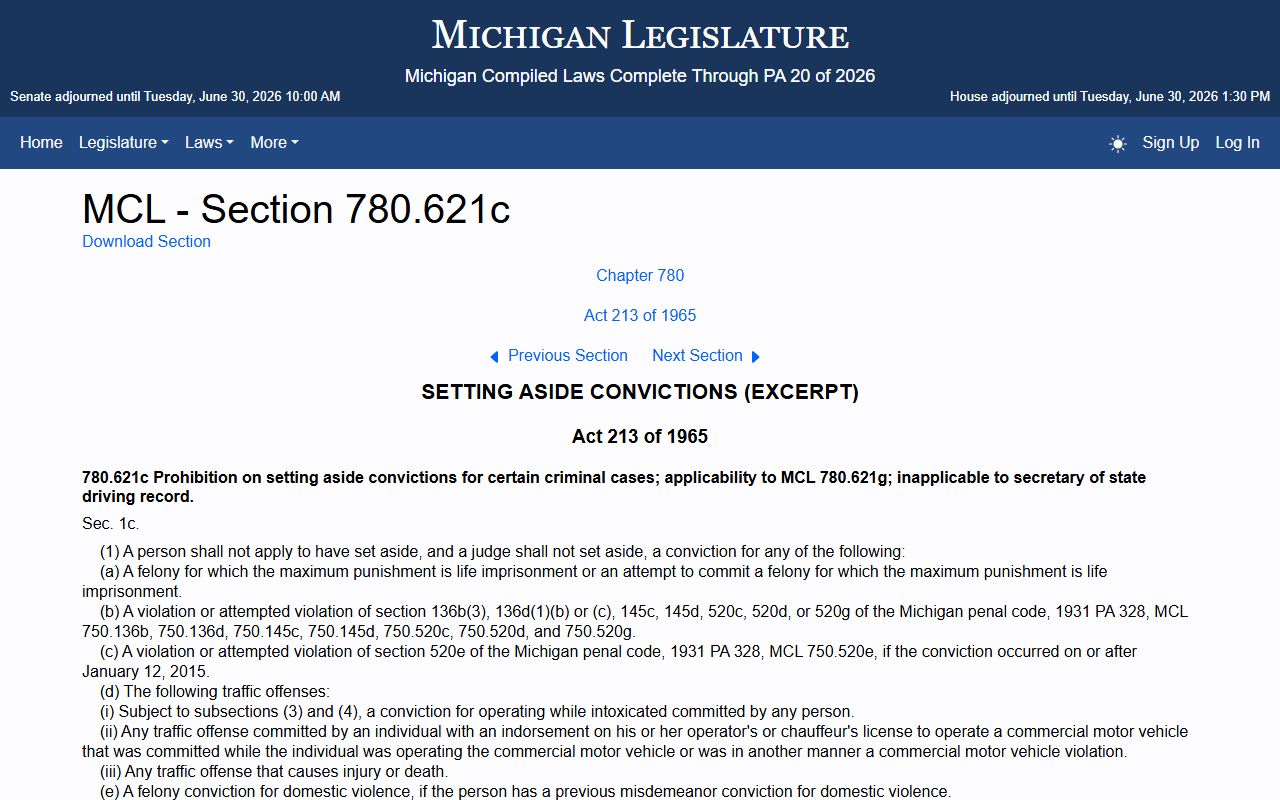
That page confirms a set aside limits public access rather than physically destroying every trace, which is why the comparison below matters.
| Sealed | Expunged (Set Aside) | |
|---|---|---|
| Visibility | Hidden from public view | Removed from ordinary public searches |
| Law Enforcement | Limited access remains | Statutory access remains for some agencies |
| Eligibility | Set by court rule and case type | Set by MCL 780.621, with waiting periods and offense limits |
Waiting periods for different conviction types are fixed by MCL 780.621d. A set aside also does not automatically rewrite every collateral record, so driving records and law-enforcement files may follow their own rules.
Statewide Criminal History Channels
A county case file shows one court's matters, but a full criminal history is compiled at the state level. The Michigan State Police run the Internet Criminal History Access Tool, or ICHAT, which searches public criminal history held by the Criminal Justice Information Center. ICHAT does not include suppressed records or warrant information.
The Michigan State Police explain the tool on their criminal history page.
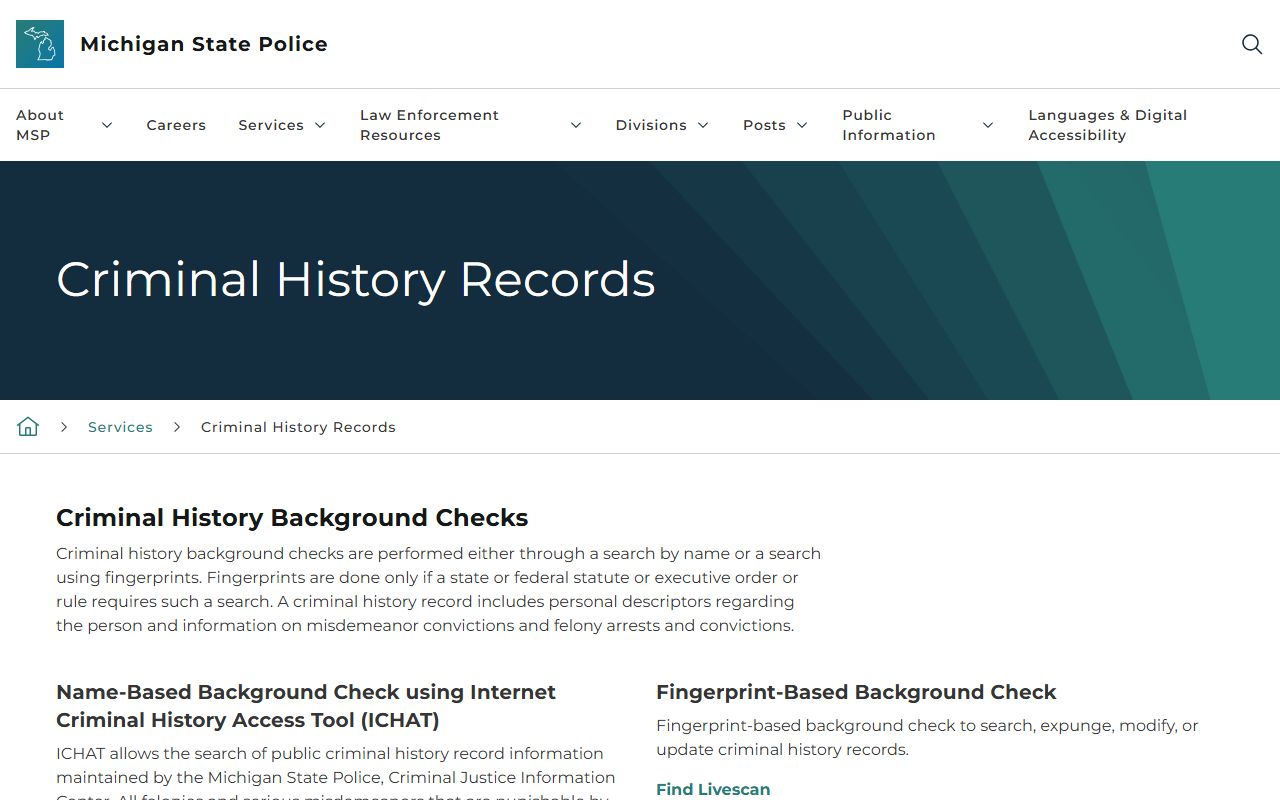
ICHAT is the right starting point for a statewide record check that reaches beyond a single Otsego court file.
For people under state custody or supervision, the Michigan Department of Corrections runs the Offender Tracking Information System, known as OTIS. It covers prisoners, parolees, and probationers currently supervised or discharged within the last three years. The OTIS search page shows how the system is organized.
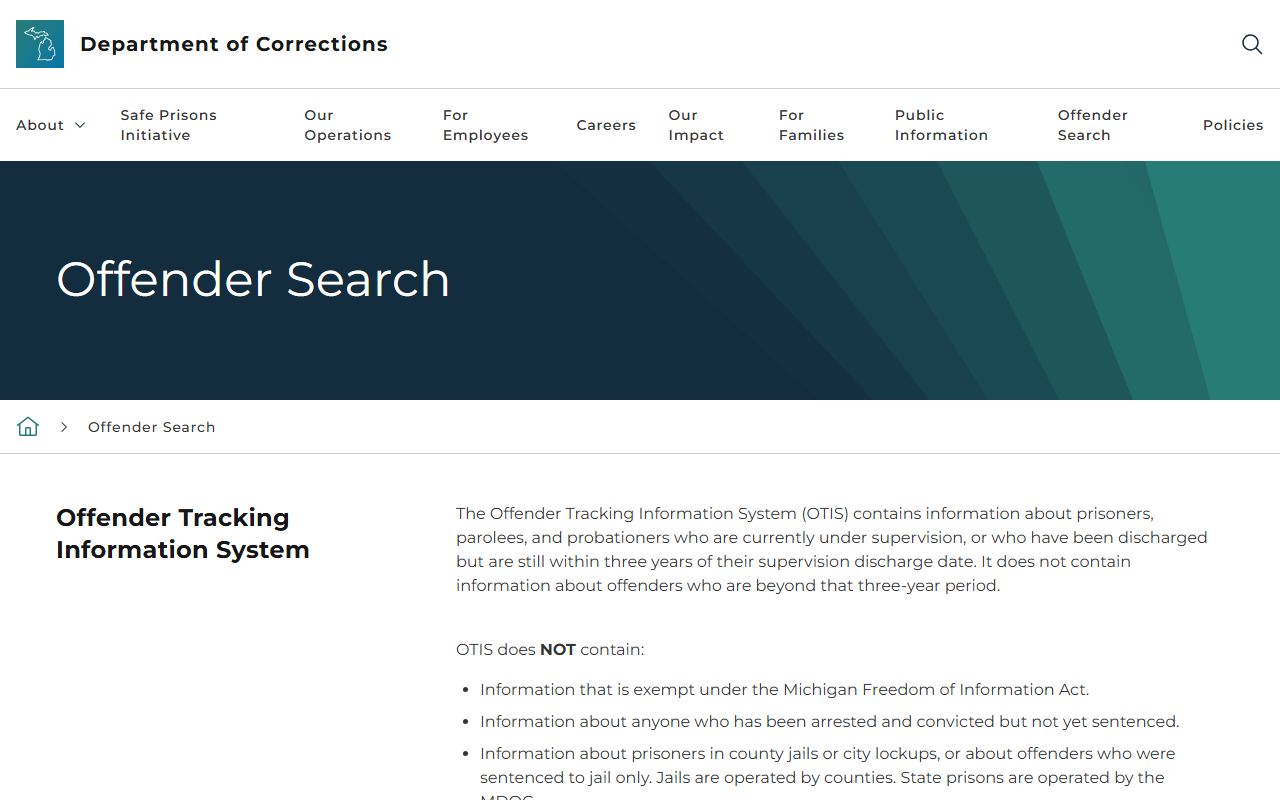
OTIS complements a court file by confirming whether a convicted person is still under Michigan corrections supervision.
Michigan Sex Offender Registry
Some criminal convictions place a person on the public sex offender registry, a separate channel from the court case file. The Michigan State Police maintain the registry and describe it on their sex offender registration page.
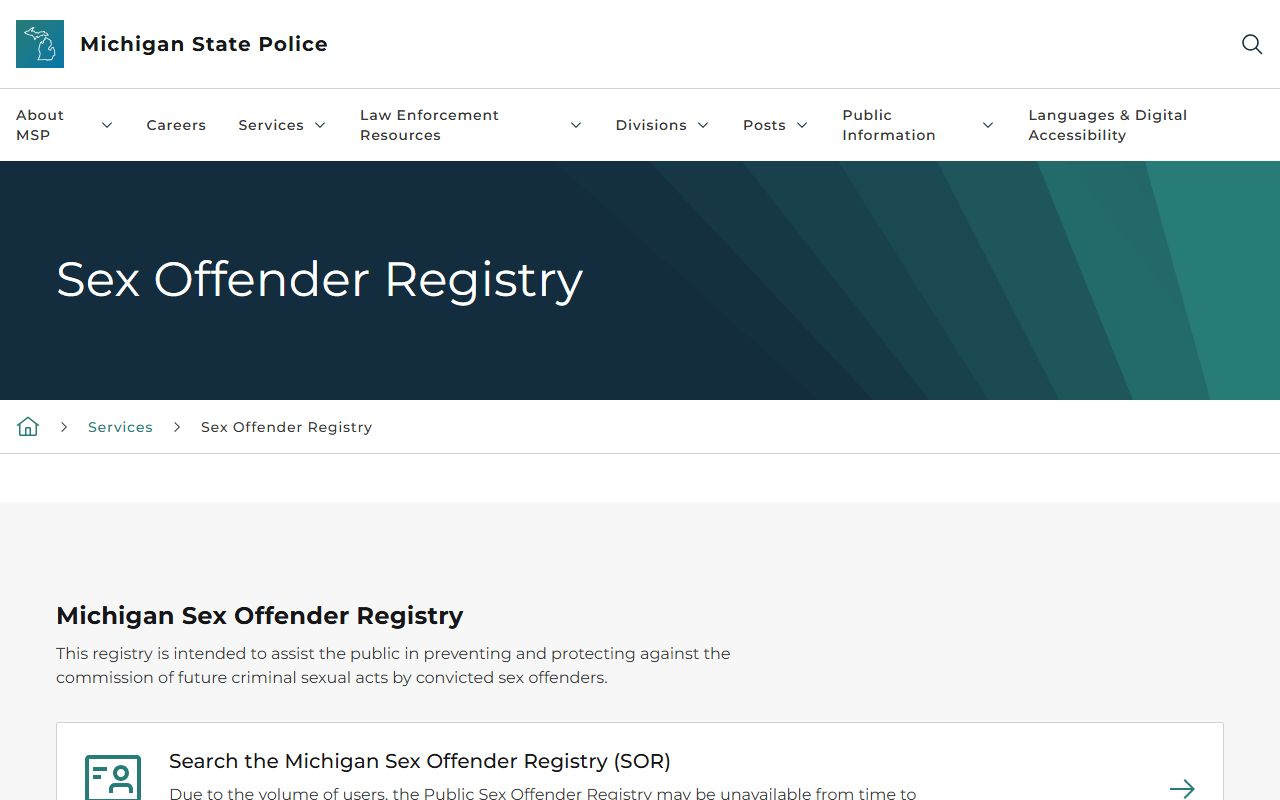
That page explains who must register and how the public listing is kept current.
The searchable side lives at the Michigan Public Sex Offender Registry, where a query needs a first and last name or a registration number plus at least one location field for an address-style search.
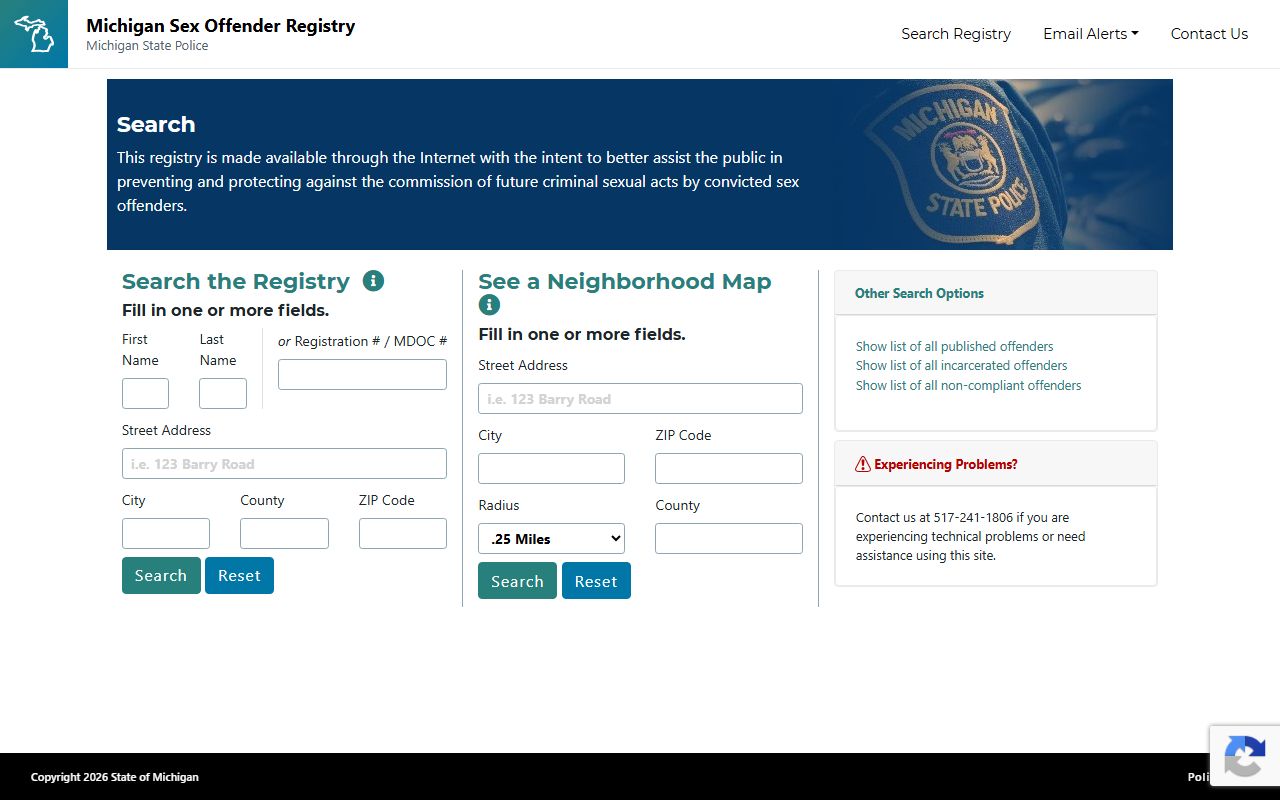
The registry rounds out a criminal background review for Otsego residents who need to check registration status alongside a court record.
Public Access to Criminal Court Records
Michigan handles court files and agency records under two different tracks. Court case records follow Michigan Court Rules, chiefly MCR 8.119, rather than the county Freedom of Information Act. Sheriff incident reports and other non-court records are the ones requested under Michigan FOIA. That split explains why a criminal case file comes from the clerk while a police report comes from the sheriff.
Key Statutes:
Michigan Court Rules 8.119 - Court records are generally accessible under court-rule procedures, with nonpublic categories set by statute or rule.
MCL 15.233 - A person may inspect, copy, or receive copies of public records from a public body unless an exemption applies.
Background Check Considerations
Public court files and ICHAT support casual and personal checks, but they are not a substitute for a regulated background report. Employers, landlords, and lenders who screen applicants must follow the federal Fair Credit Reporting Act and use a licensed consumer reporting agency. A raw court search can miss updates, mix up common names, or omit a set-aside status.
Important: This site is not a consumer reporting agency under the Fair Credit Reporting Act, and its information cannot be used for employment, credit, tenant, or insurance decisions.
Restricted Criminal Court Records in Otsego County
Several categories of criminal records stay closed to ordinary public searches. Juvenile delinquency files carry the tightest protection. Under MCL 712A.28, juvenile court records are open only by court order or to people with a statutory interest, so a public case search should not be expected to reveal juvenile case details.
Set-aside convictions drop out of routine searches once granted. Mental health commitments, adoption files, and records with protected addresses or minor names are also limited. Public copies routinely mask Social Security numbers, financial account data, and confidential attachments. When a file does not appear online, the closed status may be by design, and the clerk can confirm whether access needs a party ID or a court order.