
Otsego County Arrest Records and Court Charges
An arrest record is the account of a person being taken into custody. In Otsego County that record begins with the arresting agency, most often the Otsego County Sheriff's Office, the Gaylord Police Department, or the Michigan State Police post in Gaylord. It notes who made the arrest, the booking date and time, and the offense that prompted it. The booking detail stays with the sheriff and appears on the county jail roster, not in a court file. A separate record opens once the case reaches the court.
Being arrested does not by itself create a court charge. A prosecutor reviews what law enforcement submits and decides which charges to file, if any. Those filed charges become the court charge record, the formal list of counts the court tracks through the case. So the arrest and the charge are two linked but distinct records. The booking and custody detail sit with the sheriff and show up on the county jail roster, while the court charges after arrest are followed through the case file kept by the court clerk.
The arrest and booking side is handled by the county sheriff, whose Sheriff's Office page describes its corrections and records duties.
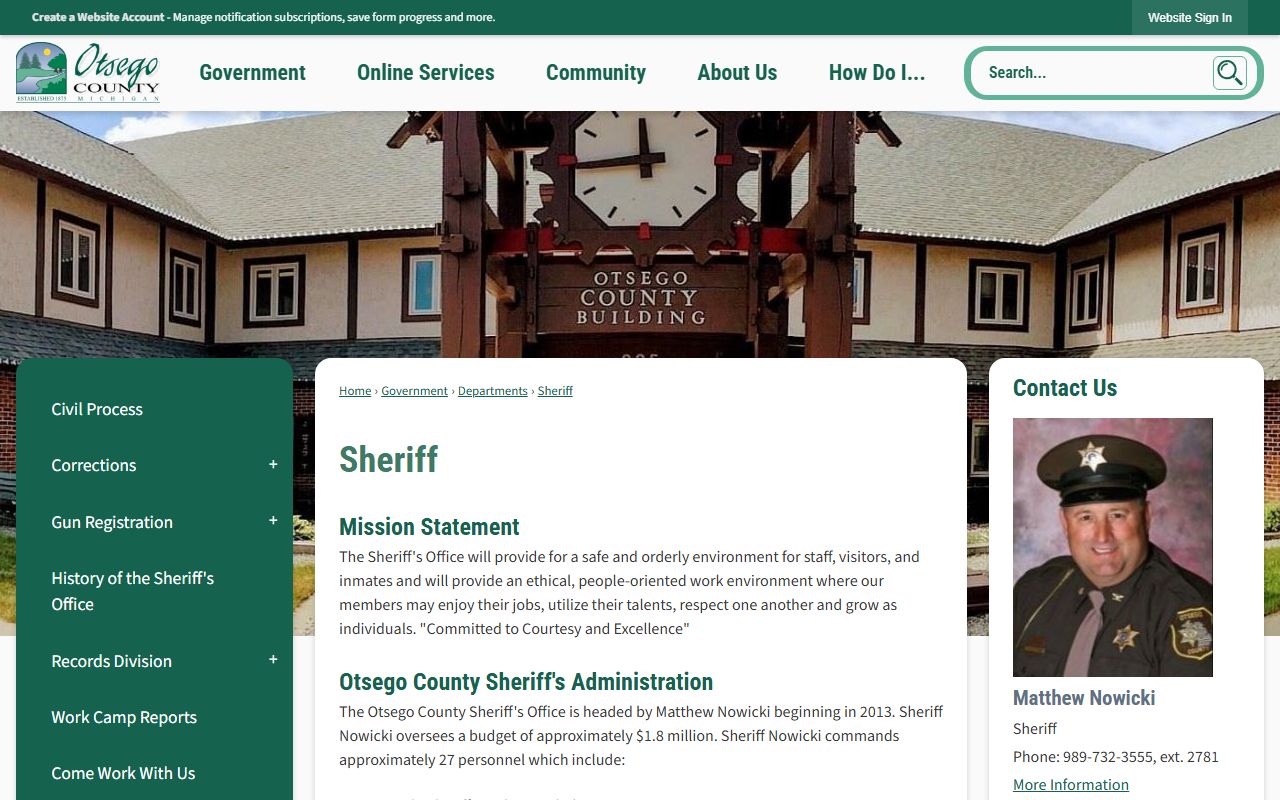
Booking entries from that office feed the weekly jail roster rather than the court's charge record, which is why the two are searched in different places.
How to Find Otsego County Arrest Records and Charges
The charges filed after an arrest surface in the court case index rather than in a booking log. The main public tool is the statewide MiCOURT Case Search, which returns criminal, traffic, and other cases from participating Michigan courts. Otsego routes 87-A District and probate cases through the Circuit46 lookup. The county Case Lookup page adds one warning that matters here: the online search does not show whether a case is in warrant status.
- Open MiCOURT Case Search and choose the Otsego court that fits the charge level, meaning the 46th Circuit Court for felonies or the 87-A District Court for misdemeanors and traffic.
- Search by the defendant's name, or by case number if you already have it.
- Open the case and read the charge list to see each count as it was filed.
- Check every charge for its code, class, and current status, since counts can change as a case moves.
For the booking side of an arrest, the weekly jail roster is the better source, and the full case outcome lives in the criminal court records file. Statewide criminal history sits in a separate system covered further down.
How Charges Get Filed After an Arrest
The path runs from the arrest forward. Booking happens first at the jail, then the charge record begins when the prosecutor files a charging document with the court. In Michigan that document takes one of three main forms depending on how serious the offense is and how the case starts. A misdemeanor often begins with a complaint, a felony usually proceeds on an information after a preliminary examination and bindover, and the most serious matters can be charged by a grand jury indictment.
| Complaint | Information | Indictment | |
|---|---|---|---|
| Filed By | Officer / Prosecutor | Prosecutor | Grand Jury |
| Common For | Misdemeanors | Many felonies | Serious felonies |
| Starts | The case | The case after bindover | The case |
The office that makes the charging decision is the Otsego County Prosecuting Attorney, and its Prosecuting Attorney page lists the office and staff.
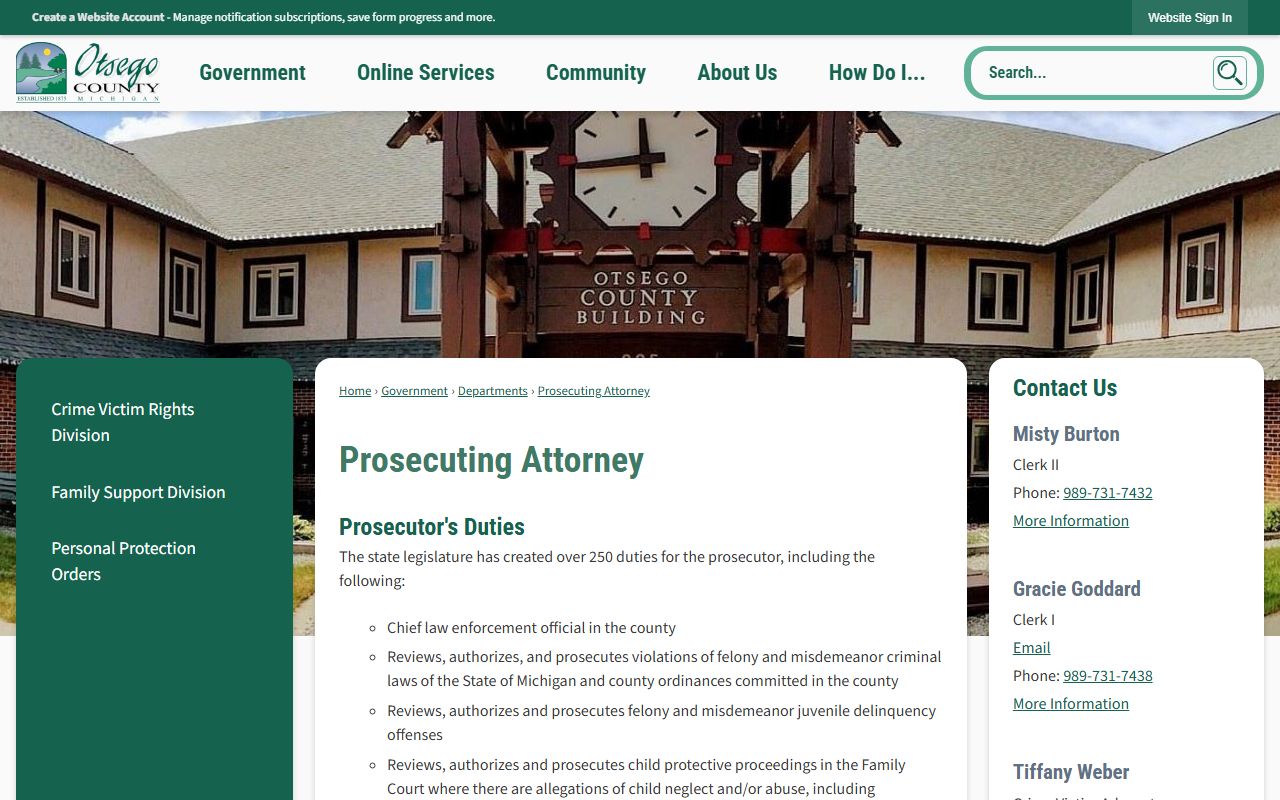
Every count on a charge record traces back to a filing decision by Prosecuting Attorney Michael A. Rola's office at 800 Livingston Boulevard, Suite 3-D, reachable at 989-731-7430. Michigan uses the title Prosecuting Attorney rather than District Attorney.
Charge Status and What It Means
Charges rarely stay frozen. As a case moves, a count can be amended, reduced, added, dropped, or dismissed, and the record shows each change. Reading the status next to a charge tells you where that count stands right now, not just what was first filed. A single case can carry several charges at once, each with its own status.
| Status | What It Means |
|---|---|
| Pending | The charge is filed and the case is open. No plea or verdict has resolved it yet. |
| Amended / Reduced | The prosecutor changed the count, often to a lesser offense as the case develops. |
| Dismissed | The court dropped the charge, so it no longer moves toward a conviction. |
| Nolle Prosequi | A Latin term meaning the prosecutor chose not to pursue that charge any further. |
Note: A dismissed or dropped charge can still appear in the public file unless the court later sets the record aside under Michigan law.
Charge Codes and Severity Levels
Every charge on an Otsego County record ties back to a specific Michigan statute or local ordinance. The charge code and offense code point to the exact law a person is accused of breaking, and the class marks how serious it is. Michigan sorts offenses into felonies, misdemeanors, and civil infractions. A felony can carry a prison term. A misdemeanor carries up to a year in jail or less. A civil infraction, such as most traffic violations, carries a fine rather than jail.
The jail roster and the court file both print a class next to each count, using labels like Felony, Misdemeanor, or Civil. One arrest often produces several separate charges, so a single booking can list a felony count beside two misdemeanors. Reading the class next to each code shows how much weight the court gives that count and which court will handle it.
Charges vs. Convictions
Being charged is not the same as being convicted. An arrest and a filed charge mean only that the state believes there is probable cause. A conviction requires proof beyond a reasonable doubt or a guilty plea accepted by the court. A charge record can list counts that were later dropped, dismissed, reduced, or that ended in acquittal, so a careful reader never treats an open or dismissed charge as proof of guilt.
| Charge | Conviction | |
|---|---|---|
| Stage | Accusation | Verdict or plea |
| Burden of Proof | Probable cause | Beyond reasonable doubt |
| Public Record | Yes | Yes |
Otsego County Sheriff Arrest Records and FOIA
The arrest itself generates paperwork on the law enforcement side that never becomes a court charge. The Otsego County Sheriff's Records Division keeps incident and accident reports written by deputies and releases many of them under Michigan's Freedom of Information Act. These reports can name the arrest, the responding officer, and the alleged facts, all separate from anything the prosecutor later files in court.
The Sheriff's Records Division page lists the reports it holds and its fee schedule.
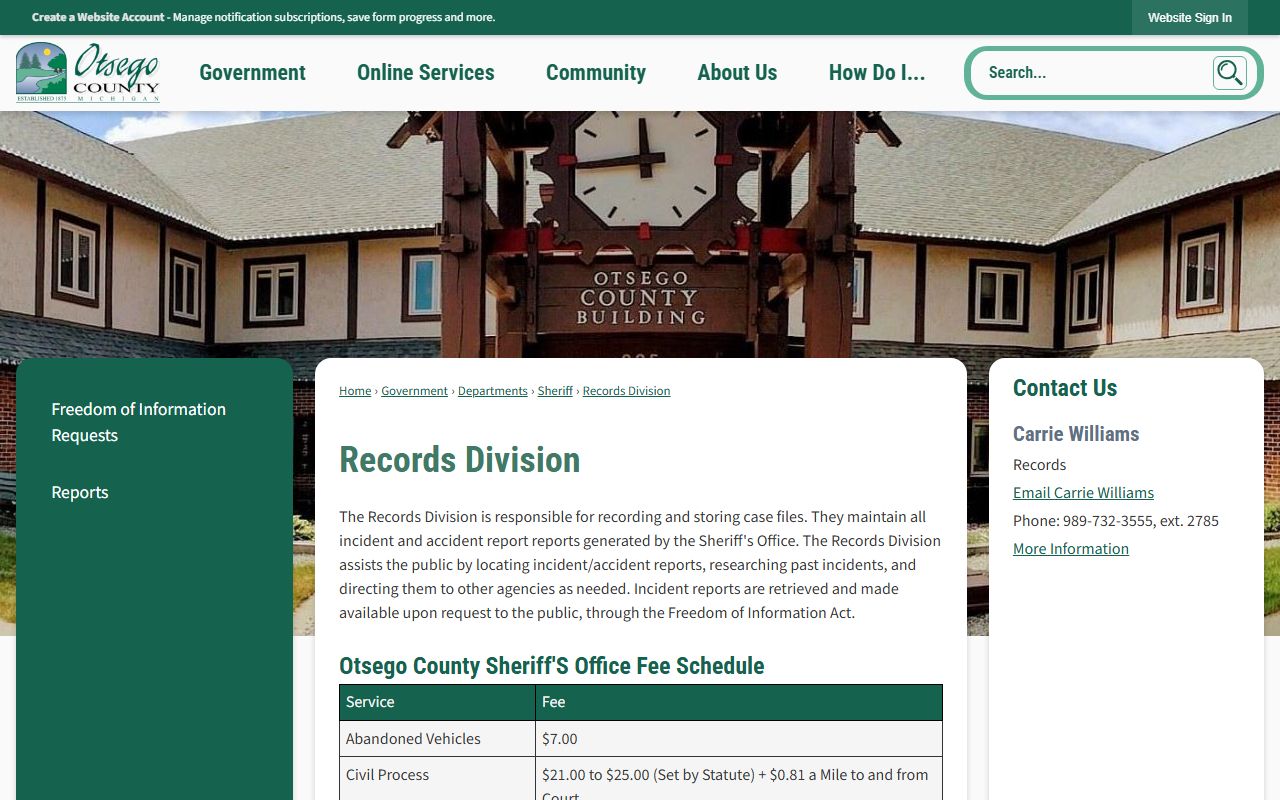
An incident report from that division is the record closest to the arrest itself, which the court charge file does not duplicate.
Getting a sheriff report means filing a FOIA request rather than searching a court portal. The Sheriff's FOIA page sets out what a request must include and how the office responds.
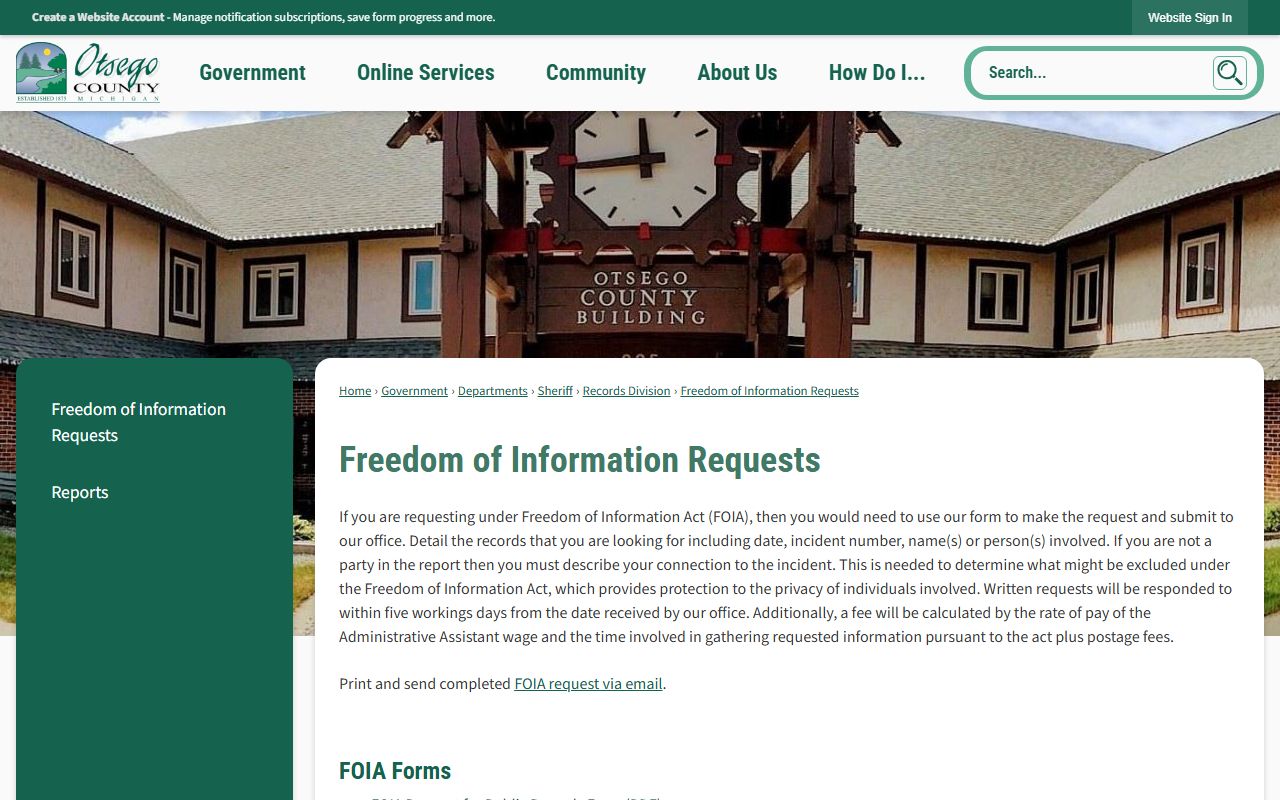
The office answers written requests within five working days and figures fees from staff time and postage. A clear request usually lists:
- The date or date range of the incident or arrest.
- The incident or report number, when it is known.
- The names of the people involved.
- The requester's connection to the report, if they are not a party to it.
Sealed vs. Expunged (Set Aside) Records
Michigan clears eligible convictions through a process it calls a set aside, though many people call it expungement. When a charge ends in a conviction that is later set aside, that count drops out of ordinary public searches. Eligibility, offense limits, and waiting periods control whether a conviction can be cleared. The waiting periods are fixed by statute.
The waiting periods for different conviction types appear at MCL 780.621d.
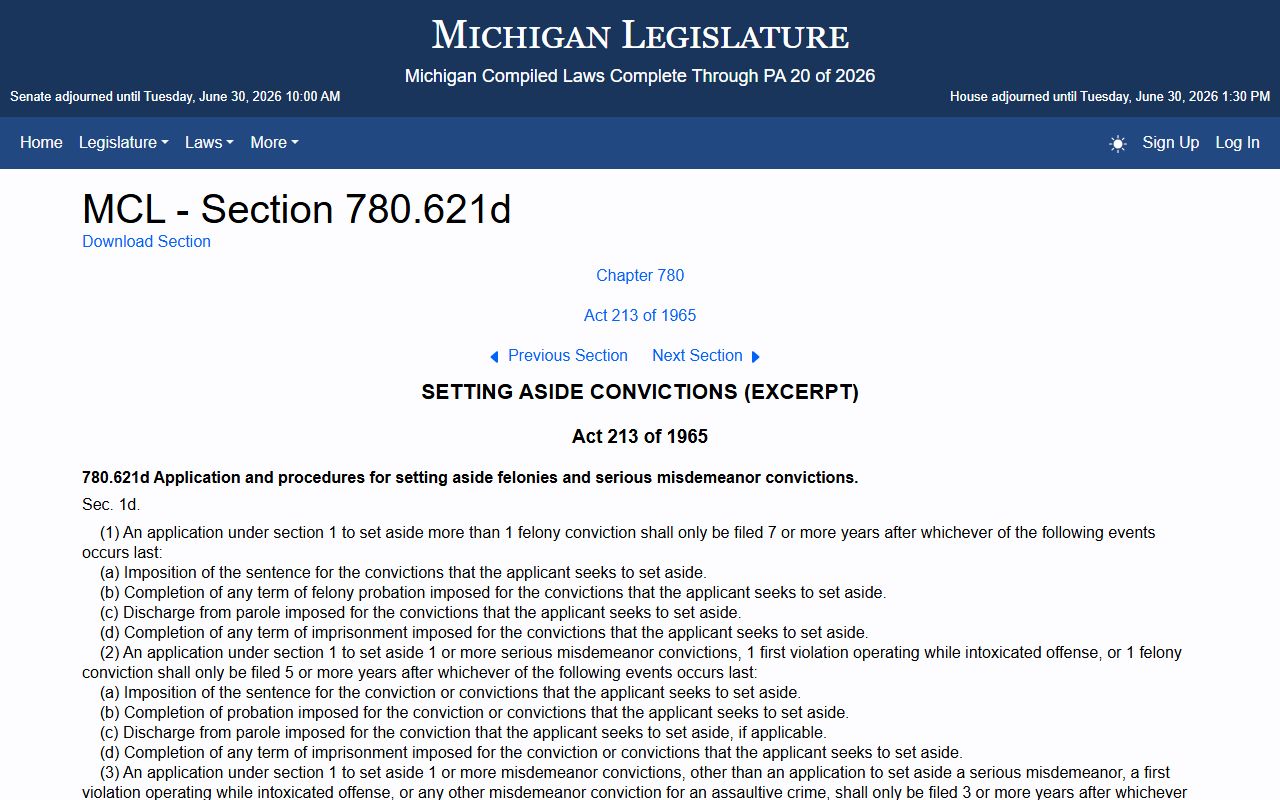
That statute confirms a set aside limits public access rather than erasing every trace, which is why sealed and expunged records still differ in practice.
| Sealed | Expunged (Set Aside) | |
|---|---|---|
| Visibility | Hidden from public view | Removed from ordinary public searches |
| Law Enforcement | Limited access remains | Statutory access remains for some agencies |
| Eligibility | Set by court rule and case type | Set by statute, with waiting periods and offense limits |
Statewide Charge and Criminal History Lookups
A single Otsego court file shows one court's charges, but a person's charges across Michigan roll up into a statewide criminal history. The Michigan State Police run the Internet Criminal History Access Tool, known as ICHAT, which searches public criminal history held by the Criminal Justice Information Center. A search there reaches past one county. ICHAT does not include suppressed records or warrant information, so it is not a warrant check. The tool is explained on the Michigan State Police criminal history page.
For a person already convicted and under state supervision, the Michigan Department of Corrections tracks current status in its OTIS system, which covers prisoners, parolees, and probationers supervised now or discharged within three years.
Background Check Considerations
Public charge records and ICHAT support casual and personal checks, but they are not a regulated background report. Employers, landlords, and lenders who screen applicants must follow the federal Fair Credit Reporting Act and use a licensed consumer reporting agency. A raw charge search can miss updates, confuse common names, or overlook a dismissed or set-aside count.
Important: This site is not a consumer reporting agency under the Fair Credit Reporting Act, and its information cannot be used for employment, credit, tenant, or insurance decisions.
Restricted Charge Records in Otsego County
Not every charge is open to a public search. Juvenile cases carry the strongest protection of all. Under the Michigan statute on juvenile records, these files open only by court order or to people with a statutory interest.
The confidentiality rule for juvenile charges is set at MCL 712A.28.
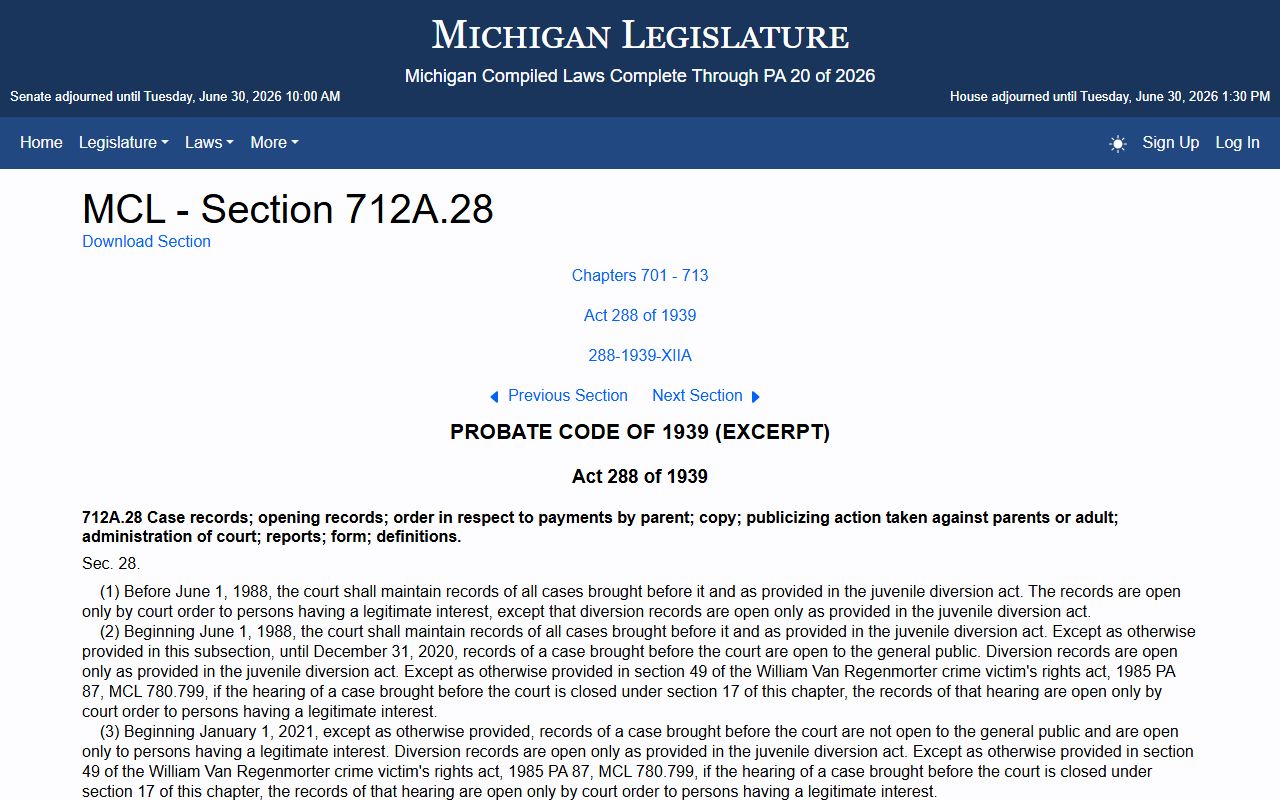
That statute keeps juvenile charge details out of an ordinary case search, so a public lookup should not be expected to reveal them.
Other charges are limited too. Set-aside convictions leave routine searches once granted. Dismissed counts can be withheld in some files, and charges tied to an open investigation may not appear at all until the case is filed. Public copies also mask Social Security numbers, protected addresses, and confidential attachments. When a charge does not show online, the closed status may be by design, and the clerk can confirm whether access needs a party ID or a court order.